More people now type a question into ChatGPT, Gemini, Copilot or Claude, or read Google's AI Overview at the top of the results, where they used to scroll a list of links. So a new trade has appeared offering to get your business into the answers, under names like GEO, AEO and LLM optimisation. The plain answer is less exciting than the sales pitch. Google says there is nothing special to do beyond being a good search result. Nobody outside these companies can guarantee you a mention. And the thing most likely to keep you out is a setting you may not know you have.
- What an AI answer actually is
- What Google says, in its own words
- The switch most people do not know they have
- New in 2026: an opt-out, and why the UK got it first
- What we saw when we watched one search
- What actually helps
- What to be wary of
- Twenty minutes: check your own
- What we are not claiming
- Our position
What an AI answer actually is
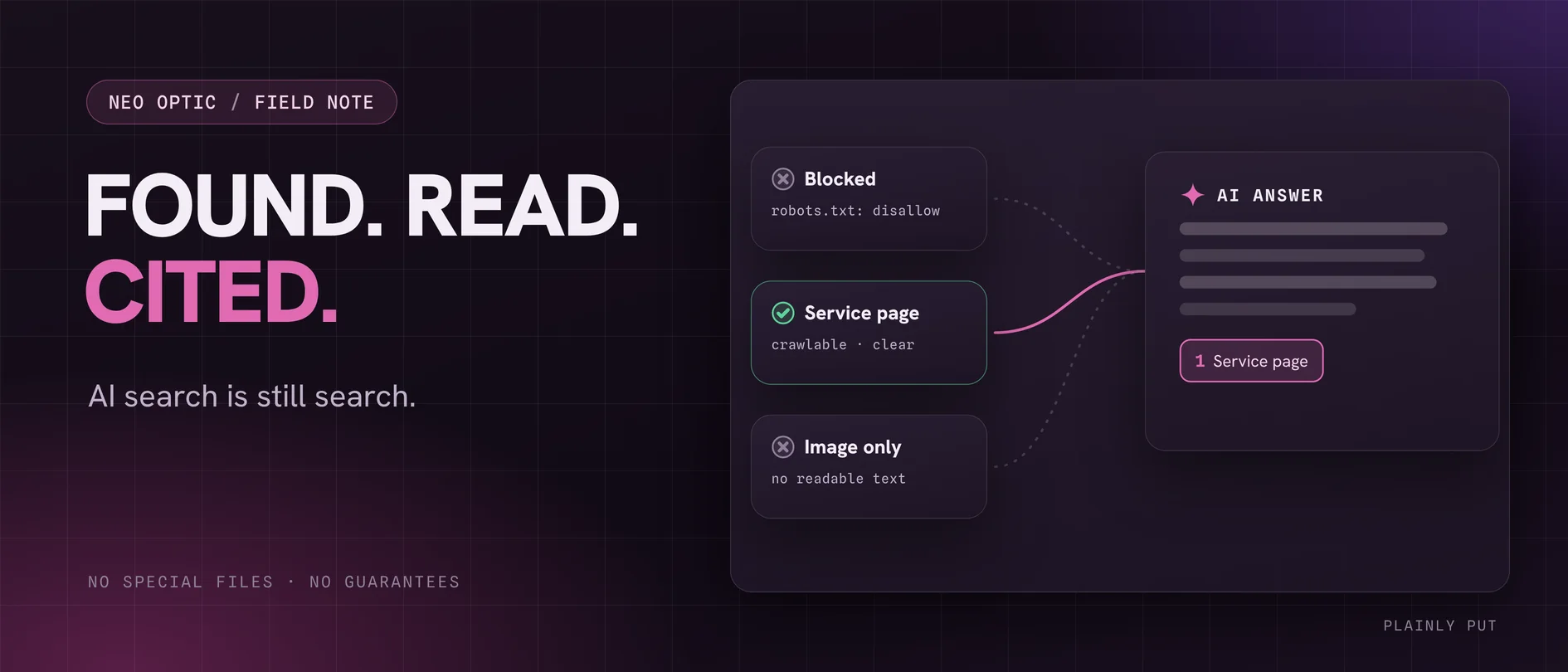
Strip away the novelty and an AI search answer works like this. The assistant searches an index of the web, reads a handful of the pages it finds, writes a summary and cites some of them as sources. The writing is new. The finding is not.
Each assistant finds pages its own way. Google's AI Overviews and AI Mode work from Google's own search index, built by the same Googlebot that has always crawled your site. OpenAI says its OAI-SearchBot crawler is what surfaces websites in ChatGPT's search results. Anthropic runs a search crawler for Claude called Claude-SearchBot. Microsoft's Copilot draws on Bing. To be cited, your page has to be in the index the assistant uses, it has to be readable, and it has to be the clearest answer to the question being asked.
That last part is where the real competition is, and it is the same competition search has always been.
AI search is still search. To be cited, a page has to be found, readable and the clearest answer to the question. Nobody can sell you a guarantee that yours will be the one chosen.
What Google says, in its own words
Google has published guidance for site owners on its AI features, and it is unusually direct. Three lines are worth quoting exactly:
- “There are no additional requirements to appear in AI Overviews or AI Mode, nor other special optimizations necessary.”
- “You don't need to create new machine readable files, AI text files, or markup to appear in these features.”
- “There's also no special schema.org structured data that you need to add.”
The same page says a page must be indexed and eligible to show a snippet in ordinary search, that neither indexing nor appearing is guaranteed, and that AI Overviews only appear when Google's systems judge them useful, so many searches do not show one at all. Visits from these features are counted in Search Console's ordinary Performance report.
So if somebody is selling you a special file or a new kind of markup as the key to appearing in Google's AI answers, Google has already said you do not need it. For any other assistant, ask the seller which company has said it uses the thing they are selling. It is a fair question, and the answer is usually silence.
The switch most people do not know they have
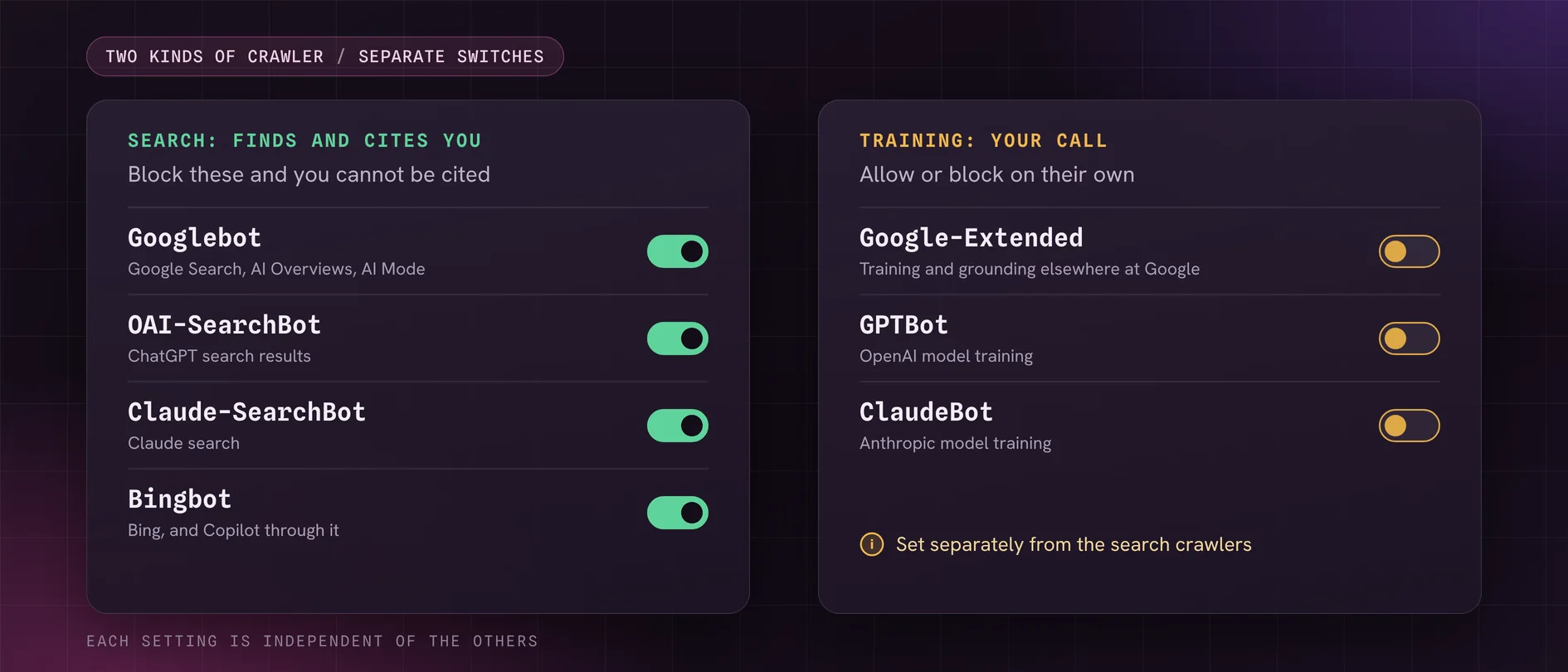
This is the part that can actually cost you. AI companies run more than one crawler, and they do different jobs. One kind collects pages that may be used to train the company's models. Another reads pages so the assistant can find and cite them when somebody asks a question. They are separate, and you can allow one while blocking the other.
- Google: Googlebot builds the search index that AI Overviews and AI Mode draw on. Google-Extended is a separate control that limits AI training and grounding in some of Google's other systems. It does not take you out of Search.
- OpenAI: OpenAI's documentation says OAI-SearchBot is used to show websites in ChatGPT's search results, while GPTBot collects content that may be used for training. It states plainly that “each setting is independent of the others”.
- Anthropic: Anthropic's help centre describes the same split: ClaudeBot collects content that could contribute to training, Claude-SearchBot improves search results, and blocking the search crawler may reduce your visibility in user searches.
The trap is a blanket “block AI bots” setting. It might be a few lines someone added to robots.txt, a switch in a security plugin, or a default at your hosting or network provider. Cloudflare, which sits in front of a large share of websites, announced in July 2025 that it would block AI crawlers by default. If a setting like that blocks the search crawlers as well as the training ones, your site simply is not there to be cited, however good it is.
Wanting to be found without being used for training is a perfectly reasonable combination. It just has to be chosen deliberately, crawler by crawler, not inherited from a default nobody looked at.
New in 2026: an opt-out, and why the UK got it first
Until this year, a site that wanted to stay in Google's ordinary results but out of its AI answers had no clean way to do it. That changed in the UK first, for a regulatory reason.
In October 2025 the Competition and Markets Authority confirmed that Google has strategic market status in general search. On 3rd June 2026 it imposed a conduct requirement on Google under that regime. According to the CMA, publishers must get effective tools to prevent their content being used to power AI features in search, the ability to opt out of their content being used for fine-tuning AI models, and clear attribution with links when their content is used. Google has nine months to implement all of it.
The same day, Google announced a new toggle in Search Console that lets a site opt out of its generative AI search features, which it lists as AI Overviews, AI Mode and AI Overviews in Discover. It started with a group of UK site owners, and Google says it reached all websites worldwide by the end of August 2026. Google also says the control will not be used as a ranking signal for ordinary results. Search Console has gained reporting on where pages appear in AI responses as well, although at launch it showed impressions, not clicks.
For most businesses that want customers, the sensible setting is to stay in. Being cited in an answer is a form of visibility, and opting out removes you from it. A publisher whose product is the content may reasonably decide otherwise. What matters is that it is now a decision you can make, and you should know which way it is set.
What we saw when we watched one search
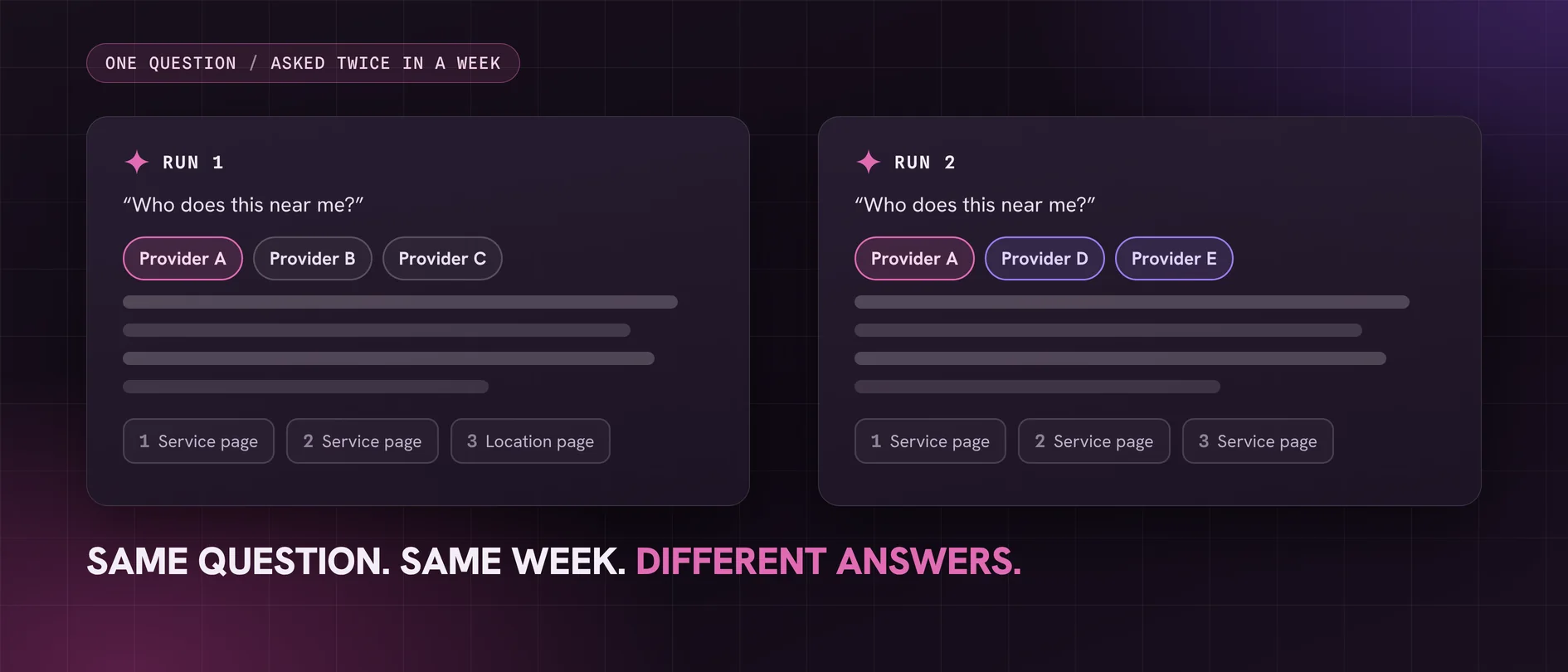
In August we watched a single local search, for accessible web design in Norwich, over several days and in three different browsers. Two things stood out.
First, the list of local businesses the AI summary named as providers changed between runs. Same question, same week, a different set of names. An AI answer is generated each time, not looked up, so any report that claims to show your “AI ranking” is showing you a snapshot of one run.
Second, look at what got cited for what. The businesses named as providers were cited from their service pages and location pages, the pages that say plainly “we do this, here”. Explainer articles, including good ones, were cited for background about the subject, not for who to hire. When the question is “who does this near me?”, the answer appears to come from pages that answer exactly that.
That is one query, watched by one agency, so treat it as an observation, not a study. But it matches what Google says about its own features, and it points at work you can actually do.
What actually helps
None of this is new, which is the point. These are the things that make a page a good search result, and they are the same things that make it a good source for an AI answer.
- Let the right crawlers in. Check robots.txt, any security plugin and any hosting or network setting, and decide crawler by crawler.
- Give each service its own page. Say what you do, where, for whom and roughly what it involves, in real text. One general page listing twelve services gives an AI very little to cite for any one of them.
- Answer the questions customers actually ask, plainly and specifically. Ranges, timescales, process, what is included. A vague page cannot be quoted precisely.
- Keep the important words in text. A price list in an image or a PDF, or a service description inside a slider, is harder for any system to read than a paragraph.
- Keep your business facts consistent. The same name, address, phone number and opening hours on your site and your Google Business Profile. Google's guidance specifically mentions keeping Business Profile information up to date.
- Use structured data where it fits, and keep it truthful. It is not required, but it helps machines understand a page. Google asks that it matches what is visible on the page.
- Say something nobody else can. Your own prices, your own process, your own observations. Pages that repeat what every other site says give an assistant no reason to choose yours.
What to be wary of
- Guaranteed placement. Our search page already asks of ordinary rankings: guaranteed by whom? Nobody outside Google controls Google, and nobody outside OpenAI controls ChatGPT. If someone guarantees you a place in AI answers, ask them to put it in the contract.
- “AI ranking” reports. Answers vary by run, by person and by place. A screenshot of one good answer proves that one answer happened.
- Special files sold as essential. See Google's own words above.
- Pages produced in bulk for machines. Google's spam policies name scaled content abuse, and the examples include using generative AI tools to generate many pages without adding value for users. A hundred thin location pages written by a tool is exactly that.
- Rewriting everything for robots. The people who arrive from an AI answer still read your page and still decide whether to call. A page turned into a list of keyword-stuffed questions loses them.
Twenty minutes: check your own
You do not need to change anything to do this. You are finding out where you stand.
- Open your robots.txt. Type your domain followed by /robots.txt into a browser. Look for a Disallow line naming Googlebot, Bingbot, OAI-SearchBot or Claude-SearchBot, or a blanket rule blocking everything. If the file is long or confusing, that is worth a question to your web supplier on its own.
- Check for an AI blocking setting. If your site uses Cloudflare, a security plugin or a managed host, look for anything labelled AI bots or AI crawlers, and find out exactly which crawlers it blocks.
- Look in Search Console. Check the Performance report, the new reporting on AI features, and how the AI features control is set for your site. If you do not have Search Console set up, that is the first job.
- Check Bing too. Copilot draws on Bing's index, and Bing Webmaster Tools is free.
- Ask the assistants yourself. Put the question your customers would ask into two or three assistants, three times each, and note which pages they cite. If they cite a directory or a competitor, read that page and ask what it says that yours does not.
- Check your Business Profile against your website. Name, address, phone number and hours should match exactly.
- Look at your analytics referrals for chatgpt.com, perplexity.ai, gemini.google.com and copilot.microsoft.com. Bear in mind that many visits from AI tools arrive without a referrer and show up as direct traffic, so this undercounts.
What we are not claiming
We are not claiming we can get you into AI Overviews or ChatGPT. Nobody outside those companies decides what they cite. We can make your site findable, readable and worth citing. That is all anyone honestly can do.
We are not claiming AI search is replacing ordinary search, or putting a figure on how much of your traffic it will take. The honest position is that nobody yet knows how this settles, and your own Search Console and analytics data will tell you more about your customers than any industry headline.
We are not claiming opting out is wrong. For most businesses that want enquiries, staying in makes sense. A publisher whose business is the content itself is in a different position.
The facts in this post are dated. Everything above was checked on 9th October 2026. This area is moving quickly, and crawler names, controls and regulation will change. The linked sources are the place to check the current position.
And our own observation is one query. It is worth sharing because it agrees with Google's published guidance, not because it proves anything on its own.
Our position
We do not treat AI visibility as a separate product. The work that makes a site worth citing is the work that makes it a good website: one clear page per service, real text, fast and accessible pages, structured data that matches what is on the page, and a robots.txt somebody has actually decided. We build sites that way anyway, which is why we would rather explain this than sell it to you as something new.
We do read the controls, though, because those are new and they can quietly cost you. Which crawlers can read your site, and how your AI features setting is configured, should be decisions somebody has made on your behalf and can explain.
If you have run the checks above and something looks wrong, or you simply are not sure what your robots.txt is doing, send us your web address. We will tell you plainly what is being blocked, what is being read, and whether anything is worth changing. Often the answer is nothing, and we will tell you that too.